

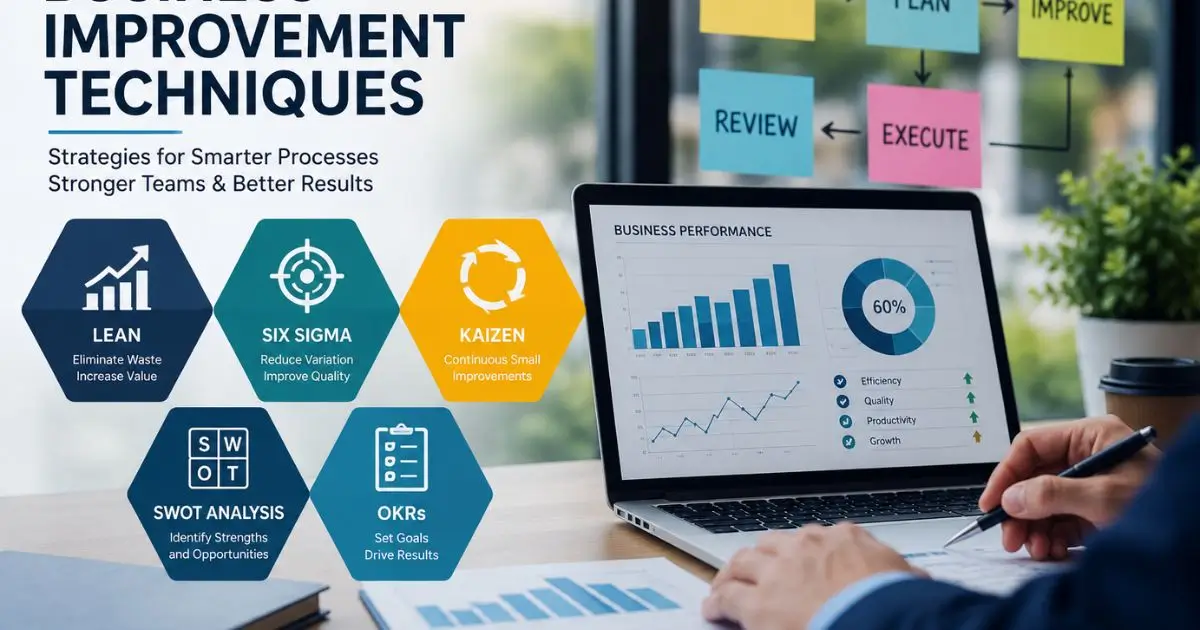
Business Improvement Techniques That Actually Work
Every business hits a point where things feel stuck. Sales plateau. Processes slow down. Teams lose focus. When that happens, most business owners don’t need a complete overhaul — they need the right improvement techniques applied in the right places.
What are business improvement techniques? They are structured methods and strategies used to identify problems, remove waste, improve performance, and help a business run more effectively. These techniques apply to operations, customer service, team management, financial performance, and more. They range from simple process reviews to data-driven frameworks used by large organizations.
This guide breaks down the most effective business improvement techniques, explains how each one works, and shows you how to apply them in a real business setting.
Quick Summary
Business improvement techniques are practical tools that help companies work smarter, cut waste, and grow steadily. Common approaches include Lean, Six Sigma, SWOT analysis, Kaizen, and OKRs. The best technique depends on your specific problem — there’s no one-size-fits-all answer. This guide explains each method clearly so you can choose what fits your business.
Why Business Improvement Matters More Than Ever
Running a business in today’s environment is harder than it used to be. Competition is sharper. Customers expect more. Costs keep rising. A business that doesn’t improve regularly tends to fall behind — not dramatically, but gradually.
The good news is that improvement doesn’t always require big spending or complete restructuring. In many cases, small systematic changes deliver the biggest results. A retail chain in Chicago reduced checkout wait times by 40% simply by mapping their customer journey and removing two unnecessary steps. No new software. No extra staff. Just a smarter process.
That’s what effective business improvement looks like in practice.
The Most Effective Business Improvement Techniques
1. Process Mapping
Before you can fix a problem, you need to see it clearly. Process mapping is one of the simplest and most powerful business process improvement tools available.
You document every step in a workflow — from start to finish — and identify where delays, errors, or redundancies occur. This technique works especially well in operations, customer service, and fulfillment.
How to use it: Pick one core process (e.g., order fulfillment or customer onboarding). Draw out every step. Mark where bottlenecks happen. Then redesign the flow to remove waste.
2. Lean Methodology
Lean is a well-known operational efficiency technique originally developed in manufacturing but now used across industries — from healthcare to software development.
The core idea is simple: eliminate anything that doesn’t add value for the customer. Lean identifies seven types of waste including overproduction, waiting, excess inventory, unnecessary movement, and defects.
A small logistics company in Texas used Lean principles to cut their order processing time from 48 hours to 18 hours by eliminating approval steps that added no real value. That’s the kind of result Lean delivers when applied well.
3. Six Sigma
Six Sigma is a data-driven approach to reducing errors and improving consistency. It’s more technical than Lean but extremely effective when quality control is the main concern.
It uses a framework called DMAIC — Define, Measure, Analyze, Improve, Control. Each phase helps teams understand a problem deeply before jumping to a solution.
Six Sigma works best in manufacturing, healthcare, financial services, and any environment where consistency and accuracy matter. It requires some training, but even a basic understanding of the DMAIC process can significantly improve decision-making.
4. Kaizen (Continuous Improvement)
Kaizen is a Japanese concept meaning “change for the better.” It’s built around the idea that small, daily improvements create massive long-term results.
Unlike big transformation projects, Kaizen encourages every employee — at every level — to suggest and test small improvements regularly. It builds a culture where improvement becomes a habit, not a one-time initiative.
Companies like Toyota have used Kaizen for decades as a core part of their operations strategy. But it works just as well for small businesses. Even something as simple as a weekly 15-minute team review of what’s working and what’s not is a form of Kaizen in practice.
5. SWOT Analysis
SWOT stands for Strengths, Weaknesses, Opportunities, and Threats. It’s one of the most widely used strategic planning tools for a reason — it’s straightforward and genuinely useful.
A SWOT analysis gives you a clear picture of where your business stands internally and externally. It helps leaders make informed decisions about where to invest, what to fix, and which risks to watch.
Use it quarterly or when facing a major business decision. It’s especially helpful when entering a new market, launching a product, or planning for the next financial year.
6. OKRs (Objectives and Key Results)
OKRs are a goal-setting framework used by companies like Google, Intel, and LinkedIn. They connect big-picture goals to measurable outcomes.
The format is simple:
- Objective: What do you want to achieve?
- Key Results: How will you measure success?
For example: Objective — Improve customer retention. Key Results — Reduce churn by 15%, increase renewal rate to 80%, improve NPS score by 10 points.
OKRs align teams around shared priorities and prevent departments from working in different directions. For small and mid-sized businesses, OKRs can replace vague annual goals with focused, trackable outcomes.
7. Customer Journey Mapping
Understanding how your customers experience your business — from first contact to post-purchase — is one of the most underused business improvement strategies.
Customer journey mapping identifies friction points where customers get confused, frustrated, or simply leave. Fixing these moments often has a direct impact on conversion rates, satisfaction scores, and repeat purchases.
A B2B software company found that 60% of trial users dropped off during the onboarding phase. By mapping the journey, they identified three unnecessary steps and removed them. Trial-to-paid conversion improved by 22% within 90 days.
8. Benchmarking
Benchmarking means comparing your business performance against industry standards or competitors. It answers the question: How are we doing relative to the best in our space?
You can benchmark almost anything — delivery times, customer satisfaction scores, cost per acquisition, employee retention rates, and more. The goal is to identify gaps and set realistic improvement targets based on what’s actually achievable in your industry.
Choosing the Right Technique for Your Business
Not every method fits every situation. Here’s a simple comparison to help you choose:
| Technique | Best For | Complexity | Time to See Results |
|---|---|---|---|
| Process Mapping | Operational inefficiency | Low | Weeks |
| Lean | Waste reduction | Medium | 1–3 months |
| Six Sigma | Quality and error reduction | High | 3–6 months |
| Kaizen | Building a culture of improvement | Low | Ongoing |
| SWOT Analysis | Strategic planning | Low | Immediate insight |
| OKRs | Goal alignment across teams | Medium | Quarterly |
| Customer Journey Mapping | Improving customer experience | Medium | 1–2 months |
| Benchmarking | Identifying performance gaps | Low–Medium | Weeks |
How to Start Improving Your Business Today
You don’t need to implement five frameworks at once. That approach leads to confusion and burnout.
Start with one clear problem. Ask yourself:
- Where is the biggest bottleneck?
- Where are we losing customers or money?
- What are employees complaining about most?
Then pick the technique that best matches that problem and run a focused improvement effort. Once you see results, build on that momentum.
Improvement is a habit, not a project
Conclusion
Understanding what are business improvement techniques is only the first step. The real value comes from choosing the right method, applying it consistently, and measuring your results honestly.
Whether you’re a small business owner looking to streamline daily operations or a manager trying to align a growing team, these techniques give you a practical starting point. You don’t need a big budget or a consulting firm — you need clarity on the problem and the discipline to follow through.
If you’re not sure where to start, begin with a simple process map of your most time-consuming workflow. What you find there will usually tell you everything.
Want to go deeper? Explore our guide on how to build a business growth strategy from scratch and our breakdown of the best tools for tracking business performance to take your improvement efforts further.
Frequently Asked Questions Business Improvement Techniques
What are business improvement techniques?
Business improvement techniques are methods that help companies reduce waste, improve efficiency, and boost performance. Popular examples include Lean, Six Sigma, Kaizen, SWOT, and OKRs.
Which technique is best for small businesses?
Kaizen and process mapping are great for small businesses because they’re affordable, simple to use, and improve daily operations.
What’s the difference between Lean and Six Sigma?
Lean removes waste and speeds up work, while Six Sigma reduces errors using data. Many businesses combine both as Lean Six Sigma.
How often should businesses review improvement strategies?
Review strategies every quarter to stay aligned with goals and adapt to changing business needs.
Can these techniques improve employee performance?
Yes. Methods like OKRs and Kaizen improve productivity by setting clear goals and encouraging employee involvement.
What are common business improvement mistakes?
Common mistakes include changing too much at once, skipping problem analysis, and treating improvement as a one-time project instead of an ongoing process.