

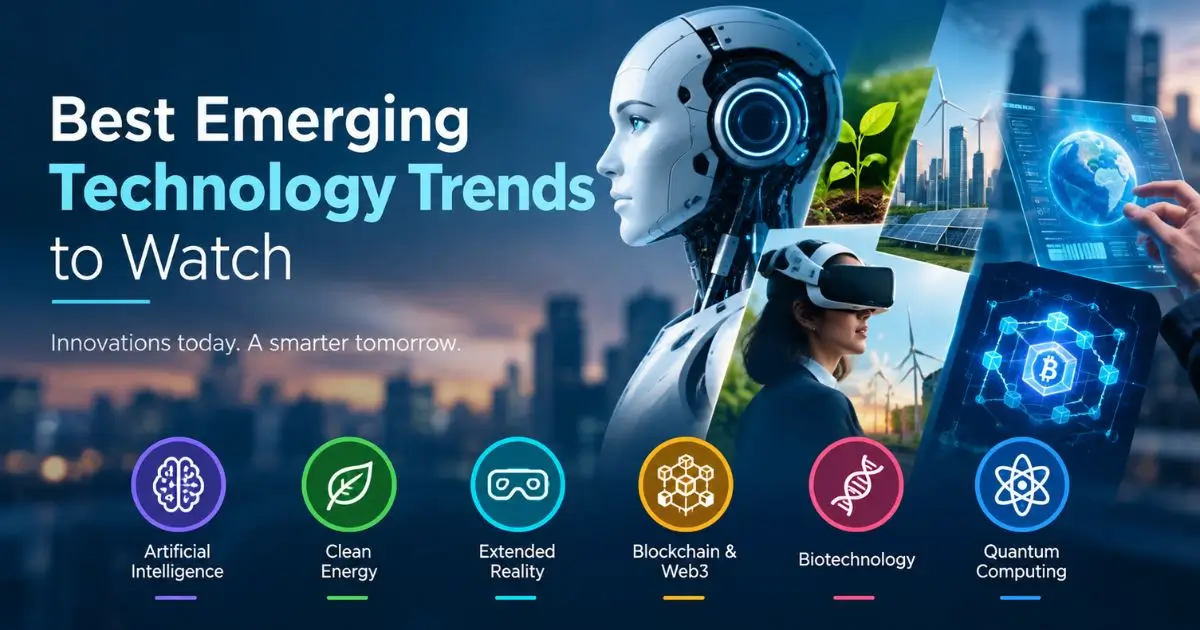
Best Emerging Technology Trends to Watch in 2026
Every year, tech headlines throw dozens of buzzwords at you. Half of them fade by March. The other half quietly reshape how businesses operate, how doctors treat patients, and how you interact with your phone.
The problem? Sorting the signal from the noise takes time most people don’t have.
If you want a clear, honest look at the best emerging technology trends to watch this year — without the hype — you’re in the right place. This guide breaks down eight technologies that are moving past the “cool demo” stage and into real-world use. You’ll learn what each one does, where it’s already working, and what limitations still exist.
Emerging technology refers to new or rapidly evolving innovations that are not yet mainstream but show strong potential to create significant economic or social impact within the next three to five years.
Quick summary
The biggest tech shifts in 2025 include agentic AI, quantum computing breakthroughs, spatial computing, edge computing, green tech, brain-computer interfaces, digital twins, and cybersecurity mesh. Most are already in early commercial use. None are magic bullets. Read on for the real picture.
1. Agentic AI (AI That Acts, Not Just Answers)
You already know generative AI. You’ve used ChatGPT or a similar tool to draft an email or summarize a report. Agentic AI is the next step.
Instead of waiting for your prompt, an AI agent can plan, decide, and execute multi-step tasks on its own. Think of it as moving from a smart assistant who answers questions to one who actually does the work.
Real example: Microsoft’s Copilot agents can now monitor your inbox, draft replies, schedule meetings, and flag urgent items — all without you clicking “generate.”
Honest take: Agentic AI is powerful but still makes mistakes when tasks get complex. Human oversight is not optional yet.
2. Quantum Computing Gets Practical
Quantum computing has been “five years away” for about a decade. That joke is getting less funny because the timeline is finally shrinking.
In 2025, companies like IBM and Google are running quantum processors with over 1,000 qubits. That’s not enough to crack encryption tomorrow, but it is enough to start solving specific problems in drug discovery, logistics, and materials science that classical computers simply cannot handle.
Real example: Cleveland Clinic partnered with IBM to use quantum computing for faster genomic research, cutting simulation times that used to take months down to days.
Honest take: Quantum computers are expensive, require near-absolute-zero temperatures, and are not replacing your laptop. They solve a narrow set of problems extremely well.
3. Spatial Computing and Mixed Reality
Apple’s Vision Pro put spatial computing on the map, but the trend goes far beyond one headset.
Spatial computing blends digital content with your physical environment. Unlike old VR that cut you off from the real world, mixed reality layers useful information on top of what you already see.
Where it’s working now:
- Surgeons at Johns Hopkins use AR overlays during spinal surgery to see 3D scans aligned with the patient’s body in real time.
- Warehouse workers at DHL use smart glasses to locate packages 15% faster.
Honest take: Consumer adoption is still slow because headsets are heavy and expensive. Enterprise use is where the real growth is happening right now.
4. Edge Computing (Processing Data Where It’s Created)
Cloud computing is great, but sending every piece of data to a distant server takes time. Edge computing processes data right where it’s generated — on the factory floor, inside a self-driving car, or on a retail store camera.
This matters because many new applications cannot afford the delay of a round trip to the cloud.
Real example: Tesla vehicles process sensor data locally on the car’s own hardware to make split-second driving decisions. Waiting for a cloud response at 70 mph is not an option.
Honest take: Edge computing does not replace the cloud. It works alongside it. The infrastructure cost for businesses can be significant upfront.
5. Sustainable and Green Technology
Climate pressure is no longer a “nice to have” talking point. It’s a regulatory and financial reality, especially in the US and EU.
Green tech in 2025 covers a wide range: solid-state batteries that charge faster and last longer, AI-optimized power grids that reduce waste, and carbon capture systems that are finally scaling beyond pilot projects.
Real example: Form Energy, a Massachusetts-based startup, is building iron-air batteries that can store renewable energy for 100 hours at a fraction of the cost of lithium-ion systems.
Honest take: Many green technologies are still more expensive than fossil fuel alternatives. Government incentives (like the US Inflation Reduction Act) are bridging that gap, but the economics are not fully there yet for every use case.
6. Brain-Computer Interfaces (BCIs)
This sounds like science fiction, but it’s happening now.
Brain-computer interfaces read neural signals and translate them into digital commands. The most advanced work is medical: helping paralyzed patients control a cursor, type messages, or operate a robotic arm using thought alone.
Real example: Neuralink’s first human patient, Noland Arbaugh, demonstrated the ability to play chess and browse the web using only his mind after receiving a brain implant in early 2024.
Honest take: BCIs are still in early clinical trials. Widespread consumer use is likely a decade or more away. Ethical and privacy concerns around brain data are serious and largely unresolved.
7. Digital Twins
A digital twin is a virtual replica of a physical object, system, or process. You feed it real-time data, and it mirrors what’s happening in the real world — letting you test changes, predict failures, and optimize performance without touching the actual thing.
Where it’s working now:
- GE Aerospace uses digital twins of jet engines to predict maintenance needs before parts fail.
- The city of Singapore built a full digital twin of the entire island to model traffic, energy use, and emergency response.
Honest take: Building an accurate digital twin requires massive amounts of sensor data and computing power. Small businesses may find the setup cost prohibitive for now.
8. Cybersecurity Mesh Architecture
As companies spread their data across clouds, remote workers, and IoT devices, the old “castle and moat” security model is falling apart.
Cybersecurity mesh is a decentralized approach. Instead of one big firewall protecting everything, security is wrapped around each individual device, user, and data asset. It’s flexible, scalable, and far harder for attackers to breach in one sweep.
Real example: After a major ransomware attack in 2023, MGM Resorts shifted toward a zero-trust mesh model, verifying every access request regardless of where it originated.
Honest take: Transitioning to a mesh architecture is complex and requires significant IT investment. But the cost of a data breach is far higher.
Quick Comparison: Which Trend Matters Most for You?
| Trend | Best For | Maturity Level | Biggest Limitation |
|---|---|---|---|
| Agentic AI | Knowledge workers, SaaS companies | Early commercial | Accuracy on complex tasks |
| Quantum Computing | Pharma, logistics, finance | Research / early pilot | Cost and hardware constraints |
| Spatial Computing | Healthcare, manufacturing, training | Early commercial | Hardware cost and comfort |
| Edge Computing | IoT, autonomous vehicles, retail | Commercial | Upfront infrastructure cost |
| Green Tech | Energy, manufacturing, transport | Scaling | Still expensive in many cases |
| Brain-Computer Interfaces | Medical rehabilitation | Clinical trials | Years from consumer use |
| Digital Twins | Aerospace, smart cities, supply chain | Commercial | Data and compute requirements |
| Cybersecurity Mesh | Any enterprise with distributed IT | Early commercial | Complex to implement |
Frequently Asked Questions
What are the best emerging technology trends?
Key trends include agentic AI, quantum computing, spatial computing, edge computing, green tech, brain-computer interfaces, digital twins, and cybersecurity.
Which technology will impact jobs most?
Agentic AI is likely to have the biggest near-term impact by automating tasks while helping workers become more productive.
Is quantum computing ready for business?
Not widely yet. It is mainly used for specialized research in areas like drug discovery, finance, and materials science.
What is green technology?
Green technology focuses on reducing environmental impact through solutions like renewable energy, energy storage, and carbon capture.
Are brain-computer interfaces safe?
Early medical trials are promising, but long-term safety data remains limited and consumer use is still developing.
Conclusion
Tracking the best emerging technology trends to watch is not about chasing every shiny new tool. It’s about understanding which innovations are solving real problems right now and which ones are still years from practical use.
If you’re a business leader, start with agentic AI and cybersecurity mesh — they offer the fastest return. If you’re in healthcare or manufacturing, spatial computing and digital twins deserve your attention. And if you’re simply curious about where the world is headed, keep an eye on quantum computing and green tech.
No single trend will change everything overnight. But together, they’re reshaping the landscape faster than most people realize.