

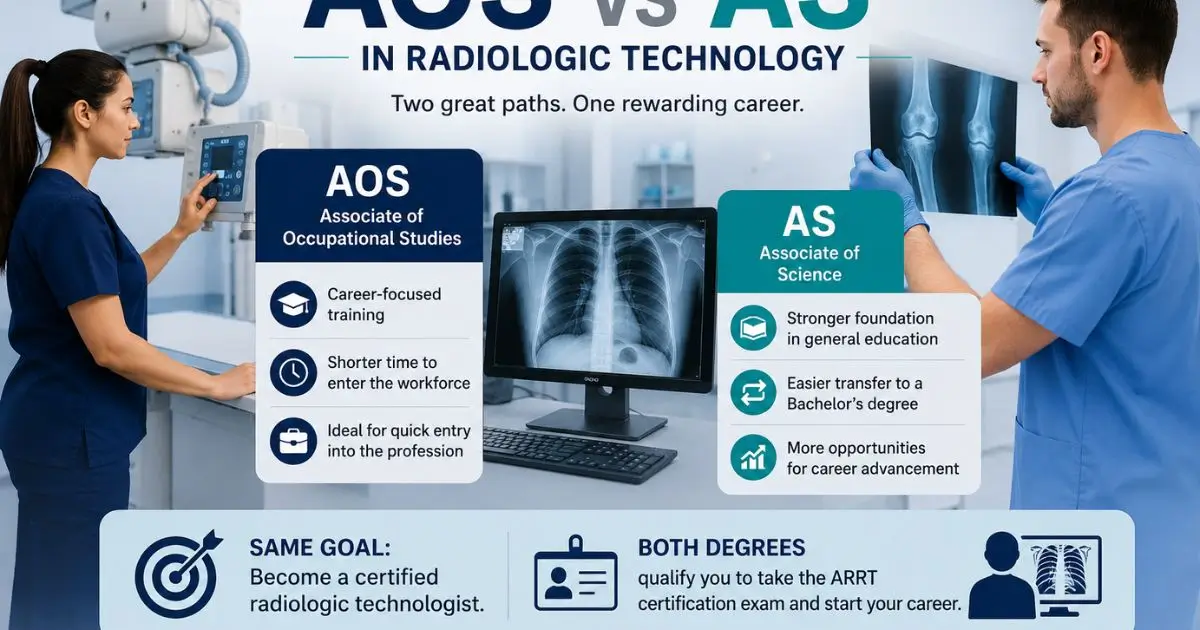
AOS vs AS in Radiologic Technology: What’s the Real Difference?
If you’re looking into a career as a radiologic technologist, you’ve probably come across two degree options: the AOS (Associate of Occupational Science) and the AS (Associate of Science). At first glance, they look almost identical. Both are two-year programs. Both prepare you to take the ARRT certification exam. Both lead to the same entry-level job title.
So why does the degree type even matter?
It matters more than most people realize — especially if you ever plan to move up in your career, transfer to a four-year program, or work in certain healthcare settings that look closely at your educational background.
This guide breaks down the AOS vs AS in radiologic technology clearly and honestly, so you can choose the path that actually fits where you’re going.
📌Quick Summary
The AOS is designed purely for workforce entry — it’s practical, fast, and career-focused. The AS includes more general education courses and is better for anyone who may want to transfer to a bachelor’s program later. Both qualify you to sit for the ARRT exam. Your long-term goals determine which one is right for you.
What Is an AOS in Radiologic Technology?
The Associate of Occupational Science (AOS) is a career-focused, applied degree. It’s built specifically to prepare you for the workforce as quickly and efficiently as possible.
In an AOS program, most of your coursework is directly related to your field — radiographic positioning, imaging equipment, patient care, radiation protection, and clinical practice. You won’t spend a lot of time taking general education classes like English composition or sociology. The focus is almost entirely on the technical skills you need to become a working radiologic technologist.
This makes the AOS a strong choice if your only goal right now is to get your ARRT credentials and start working in a hospital, imaging center, or outpatient clinic.
What Is an AS in Radiologic Technology?
The Associate of Science (AS) is a more traditional academic degree. It prepares you for the same entry-level radiologic technology career, but it also includes a broader set of general education requirements — things like college-level math, English, anatomy, biology, and sometimes psychology or communication courses.
These general education credits serve a specific purpose: they transfer. If you ever decide to pursue a Bachelor of Science in Radiologic Sciences or a related health field, those credits from your AS degree will likely count toward your four-year program.
Think of the AS as a degree with a built-in exit ramp toward further education.
AOS vs AS in Radiologic Technology: Side-by-Side Comparison
Here’s a clear look at how these two degrees compare across the areas that matter most.
| Feature | AOS | AS |
|---|---|---|
| Full Name | Associate of Occupational Science | Associate of Science |
| Primary Focus | Career/workforce ready | Academic + career ready |
| General Education Courses | Minimal | Moderate to extensive |
| Transferability to BS Program | Limited or difficult | Much easier |
| Time to Complete | ~2 years | ~2 years |
| ARRT Exam Eligibility | Yes | Yes |
| Cost | Often lower overall | May be slightly higher |
| Best For | Career-focused students | Students planning to advance |
Both degrees meet the minimum requirements to sit for the ARRT (American Registry of Radiologic Technologists) certification exam. From an employer’s perspective at the entry level, the difference is often small.
How the Coursework Actually Differs
This is where you feel the difference most clearly.
In an AOS program, your schedule looks something like this:
- Radiographic positioning and procedures
- Radiologic physics and equipment operation
- Radiation biology and protection
- Patient care techniques
- Clinical rotations (hands-on hospital training)
In an AS program, you get all of that, plus:
- English composition
- College algebra or statistics
- Anatomy and physiology (often more in-depth)
- Communication or public speaking
- Electives in social sciences or humanities
The AS takes longer on paper but often ends at the same two-year mark because programs are carefully designed to balance both sides of the curriculum.
Which Degree Gets You Hired Faster?
Honestly? In most cases, the degree type doesn’t decide who gets hired — your ARRT certification does.
Once you pass the ARRT exam, you’re a registered radiologic technologist. Most hiring managers at hospitals and imaging centers care about that credential far more than whether your degree says AOS or AS on it.
That said, some large healthcare systems in cities like Chicago, New York, or Los Angeles have started showing preference for candidates with broader educational backgrounds — or those actively working toward a bachelor’s degree. If you’re applying in a competitive market, the AS may give you a slight edge.
For rural or smaller healthcare markets across the US, the AOS is completely respected and commonly seen.
Career Advancement: Where the Difference Really Shows Up
Here’s the honest truth about long-term career growth in radiologic technology.
If you want to move beyond staff radiologic technologist into roles like:
- Lead technologist or supervisor
- Radiologist assistant
- CT or MRI specialist
- Healthcare administrator
- Radiology educator
…you will almost certainly need at least a bachelor’s degree, possibly a master’s.
This is where the AOS vs AS in radiologic technology decision becomes critical.
If you have an AOS, transferring into a BS completion program can be complicated. Many four-year colleges won’t accept your occupational science credits as academic credits. You may end up repeating courses you already took.
If you have an AS, the general education credits transfer smoothly. You can finish a BS completion program in as little as 12–18 additional months in some cases.
A real-world example: A graduate from a community college in Texas completes an AS in radiologic technology, works for two years, then enrolls in an online BS completion program. Because her general education credits transfer, she finishes her bachelor’s in 14 months while still working full-time. This path is significantly harder — sometimes impossible — starting from an AOS.
Salary Considerations
Neither degree type directly changes your starting salary. Entry-level radiologic technologists in the US earn around $55,000–$65,000 per year on average, according to the Bureau of Labor Statistics. Some metropolitan areas pay considerably more.
Where education matters for salary is at the higher levels. Radiologists assistants, imaging directors, and advanced-level technologists consistently earn more, and those roles require higher credentials — which are easier to reach if you started with an AS.
Which One Should You Choose?
Here’s a simple framework to help you decide:
Choose the AOS if:
- You want to enter the workforce as quickly as possible
- You have no plans to pursue a bachelor’s degree
- You’re career-changing and need a practical, efficient path
- Cost is a primary factor and you want to minimize elective coursework
Choose the AS if:
- You think you might want a bachelor’s degree later
- You want more flexibility in your career path
- You’re early in your academic journey and general education credits feel valuable
- You’re applying to programs at community colleges or universities that offer the AS as their standard degree
If you’re unsure, the AS is almost always the safer bet. It doesn’t limit you the way an AOS can.
Conclusion
The choice between an AOS and AS in radiologic technology is not about which degree is “better” in general — it’s about which one fits your specific situation.
If you’re focused entirely on getting your ARRT credentials and starting work, the AOS does that job well. If there’s any chance you’ll want to grow beyond staff-level work, the AS gives you room to move.
When in doubt, choose the path that keeps the most doors open.
Thinking about your next step in radiologic technology education? Explore accredited programs in your state and ask each program director directly which degree they offer and how transfer credits are handled at local universities. That one conversation can save you years of extra coursework.
Frequently Asked Questions
Which is better: AOS or AS?
Both qualify for ARRT certification. An AS offers easier transfer to a bachelor’s degree, while an AOS is best for entering the workforce quickly.
Can I transfer an AOS to a bachelor’s program?
Yes, but it’s often more difficult because some AOS credits may not transfer. An AS usually transfers more easily.
Do employers prefer AOS or AS?
Most employers prioritize ARRT certification over degree type. An AS may provide better opportunities for future career advancement.
How long do these degrees take?
Both AOS and AS programs typically take about two years to complete.
Can I become a Radiologist Assistant with an AOS?
Yes, but the path is usually longer. An AS provides a smoother route to a bachelor’s and master’s degree.
Are both AOS and AS programs accredited?
Yes, if they are JRCERT-accredited. Always verify the program’s accreditation before enrolling.