

John Deere Precision Construction Technology Explained: A Complete Guide
Construction has always been a game of accuracy. A blade that cuts two inches too deep. A grade that slopes slightly wrong. These small errors cost thousands of dollars and weeks of rework. That’s exactly the problem John Deere precision construction technology was built to solve.
Over the past decade, the construction industry in the US has been moving away from guesswork and toward data-driven machine control. John Deere has been at the center of that shift — bringing GPS, sensors, automation, and connected software together into equipment that works smarter on every job site.
Whether you’re a contractor trying to understand your new machine, a project manager evaluating technology investments, or someone curious about how modern construction equipment works — this guide explains everything clearly.
Definition: John Deere precision construction technology refers to a suite of GPS-based, sensor-driven, and software-connected systems integrated into John Deere equipment. These systems help operators grade, dig, and move material with greater accuracy, reduced waste, and improved job site efficiency — often with automated or semi-automated machine control.
Quick Summary
John Deere precision construction technology uses GPS, machine control, and connected software to help construction equipment work more accurately and efficiently. It reduces rework, saves fuel, and helps operators finish jobs faster — even in challenging conditions.
Why Precision Matters on a Construction Job Site
Before diving into what the technology does, it’s worth understanding why it matters.
Traditional construction relies heavily on the operator’s skill and experience. Survey stakes are placed in the ground, the operator reads them, and they try to match grades by eye and feel. Skilled operators do this well — but it still leaves room for error, especially on large or complex projects.
A grading mistake on a highway project, for example, doesn’t just waste time. It wastes fuel, material, and labor. You might have to regrade an entire section, delay paving, and push back the whole project schedule.
Precision technology changes that equation. Instead of relying solely on operator judgment, the machine itself knows where it is, what grade it needs to reach, and how deep to cut — in real time.
What Is John Deere SmartGrade Technology?
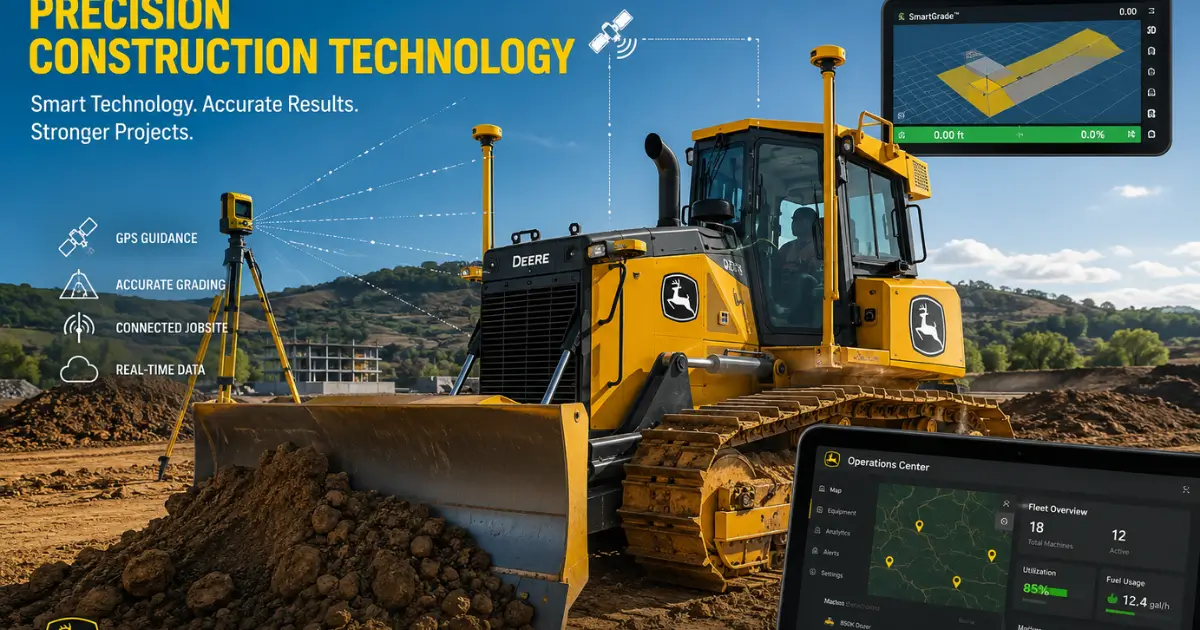
One of the most important systems under the John Deere precision umbrella is SmartGrade. This is John Deere’s integrated machine control system, available on motor graders and dozers.
SmartGrade uses GPS and sonic sensors to continuously track where the blade is relative to the design grade. When the operator is close to target elevation, the system can automatically control blade height to prevent overcutting.
Here’s what makes SmartGrade different from aftermarket systems: it’s fully factory-integrated. The GPS antenna, the sensors, the display, and the hydraulic controls are all built in from the factory. There are no external brackets, no add-on cables running across the cab, no risk of damage during transport.
On a road project in Texas, for example, a grading crew using SmartGrade-equipped machines reported finishing a half-mile section of subgrade prep in about half the time it normally took — because operators spent far less time checking stakes and far more time working productively.
Key Technologies Inside John Deere Precision Systems
Let’s break down the main technologies that make this work.
1. GPS Machine Control
GPS antennas mounted on the machine communicate with satellites and base stations to pinpoint the machine’s exact position — often within a centimeter or two. This positional data is compared against a digital terrain model (the 3D design of what the finished grade should look like).
The machine always knows where it is on that design, in real time.
2. Grade Control Displays
Operators see a clear, easy-to-read display in the cab. It shows the current blade position, how far the machine is from target grade, and whether the operator needs to raise or lower the blade. Modern displays on John Deere equipment use simple color-coded visuals — even less experienced operators can learn them quickly.
3. Automatic Blade Control
In automatic mode, the machine makes small, continuous hydraulic adjustments to keep the blade exactly on grade. The operator steers and handles the bigger movements — the system handles the fine-tuning.
This doesn’t replace the operator. It makes the operator more productive and consistent.
4. John Deere Operations Center
This is the connected software side of precision technology. The John Deere Operations Center is a cloud-based platform that lets fleet managers and project supervisors track machine location, hours, fuel use, and diagnostic alerts — all from a laptop or phone.
If a machine starts burning more fuel than usual, the system flags it. If a dozer is working in the wrong zone of a project, a supervisor can catch it early. It turns individual machine data into useful fleet intelligence.
5. Payload Weighing Systems
On John Deere articulated dump trucks and wheel loaders, payload weighing technology calculates how much material is loaded in real time. Operators can load trucks to their exact target weight — no overloading, no underloading, less guessing.
Over a full shift, this adds up to significantly better efficiency and lower fuel consumption per ton moved.
How It Compares to Traditional Methods
| Feature | Traditional Method | John Deere Precision Technology |
|---|---|---|
| Grade accuracy | Depends on operator skill | Centimeter-level GPS accuracy |
| Rework frequency | Higher — errors common | Lower — real-time correction |
| Operator learning curve | Years to master | Faster with guided displays |
| Fuel efficiency | Variable | Improved by reducing overcutting |
| Project data visibility | Paper logs, estimates | Live data via Operations Center |
| Staking required | Yes, full layout needed | Reduced — digital model used |
Real Benefits Contractors Are Seeing
The numbers being reported across US job sites are hard to ignore.
Reduced rework. When the machine is automatically maintaining grade, there are fewer passes required and fewer spots that need correction. Some contractors report reducing rework by 30–50% on grading projects.
Lower fuel costs. Overcutting wastes fuel twice — once when you cut too deep, and again when you bring material back in. Precision control prevents that cycle.
Faster project timelines. Less rework means faster completion. On a competitive bid environment, finishing even a few days early can protect margins and open up the next project sooner.
Better outcomes for less experienced operators. This might be the biggest benefit the industry doesn’t talk about enough. With experienced operators retiring faster than new ones are entering the trade, precision technology helps newer operators perform closer to expert-level results.
Honest Limitations to Know About
No technology is perfect, and it’s worth being clear about the limitations.
Initial cost. Precision-equipped machines cost more upfront. For small contractors working on simple residential grading jobs, the ROI may not justify the investment immediately.
Training required. The technology is intuitive, but it still takes time to learn. Operators need proper training to use it effectively — especially the software side.
Signal dependency. GPS-based systems need a clear sky view to work accurately. In dense urban environments, near tall structures, or in areas with heavy tree cover, signal quality can drop and accuracy may be affected.
Digital design files needed. To use machine control, you need a 3D design file of the project. Not every project comes with one, and creating them requires additional software and skill.
Who Is This Technology Best Suited For?
John Deere precision construction technology delivers the strongest value to:
- Commercial and civil construction contractors working on roads, site development, and earthworks projects
- Large fleet operators who benefit most from Operations Center data and efficiency insights
- Companies dealing with skilled labor shortages who need technology to bridge the experience gap
- Government infrastructure projects where accuracy specs are strict and rework costs are high
Smaller landscaping or residential grading operations may find simpler grade control solutions more cost-appropriate — but as these systems become more standard, the price gap is narrowing.
conclusion
John Deere precision construction technology represents one of the most practical shifts in how construction work gets done. It doesn’t replace skilled operators — it makes them more capable, more consistent, and more productive.
If you’re evaluating equipment purchases, planning a large project, or simply trying to understand what modern construction technology looks like, precision systems are worth understanding thoroughly. The job sites adopting them are finishing faster, wasting less, and building more accurately than those still working the traditional way.
If you found this guide useful, explore our related articles on GPS machine control systems and construction fleet management software — both of which connect directly to this topic.
Frequently Asked Questions (FAQ)
What is John Deere precision construction technology?
It combines GPS, sensors, automation, and connected software to improve grading, digging, and earthmoving accuracy while reducing rework and boosting productivity.
How accurate is John Deere SmartGrade technology?
SmartGrade can achieve accuracy of about 3/8 inch (1 cm) with proper GPS setup, making it ideal for most construction and earthmoving projects.
Does John Deere precision technology work with other brands?
Yes. It supports common 3D design files and integrates with many industry platforms, though John Deere’s own systems offer the best compatibility.
Is it worth the cost for small contractors?
For large or frequent earthmoving projects, it delivers strong ROI through better efficiency. Smaller contractors may find aftermarket grade control more cost-effective.
What training is required?
Most operators learn the basics within a few hours to a few days. Advanced features may require extra training through John Deere dealers.
The Future of Precision Construction
John Deere is expanding automation and connected technology, including semi-autonomous machine control. As these systems evolve, operators will focus more on supervision while machines handle precision tasks, giving early adopters a competitive edge.