

What Is a Business? Types, Examples & How It Works
Most people use the word “business” every single day. But when someone asks you to explain exactly what a business is — what it does, how it works, and what makes it different from a hobby or a job — the answer isn’t always as simple as it sounds.
Whether you’re a student trying to understand the basics, someone thinking about starting your own company, or just curious about how the economy works, understanding what of business means at its core is genuinely useful knowledge.
This guide breaks it all down — clearly, practically, and without unnecessary jargon.
Quick Summary
A business is any organization or activity that produces or sells goods and services to earn money. It can be run by one person or thousands. The key goals are creating value, serving customers, and generating profit or income.
What Exactly Is a Business?
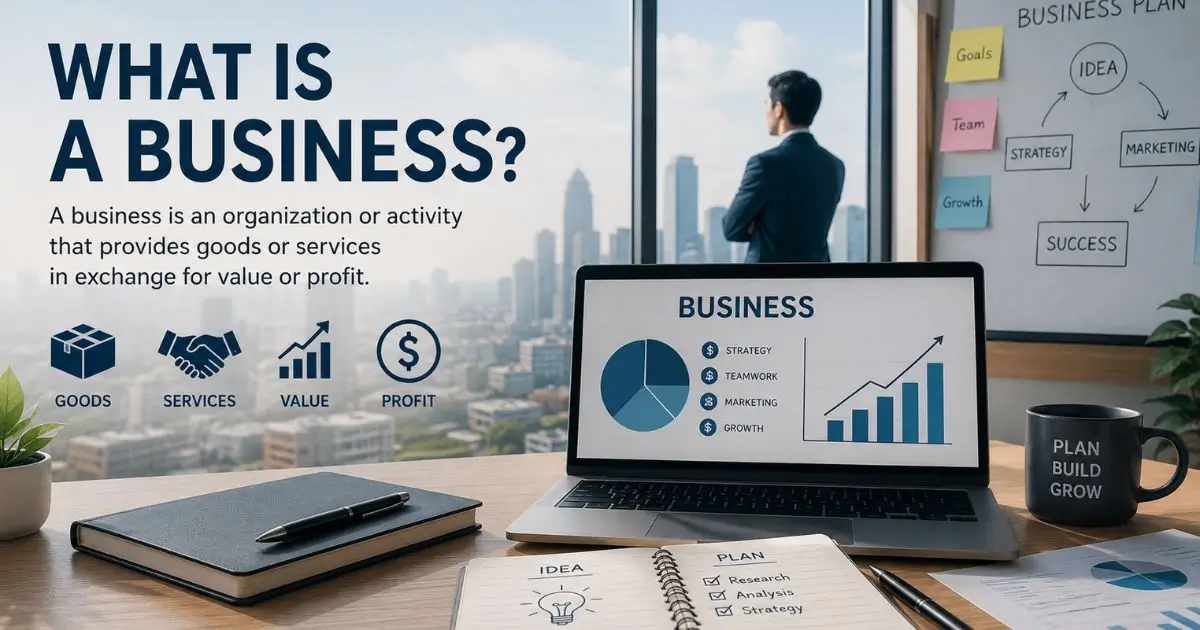
A business is an organization, enterprise, or individual activity that involves producing, buying, or selling goods and services with the goal of making a profit or sustaining income. It operates within a legal and economic structure, serves a defined group of customers, and aims to create value in exchange for money.
That definition covers a lot of ground — from a teenager mowing lawns on weekends to Apple Inc. selling iPhones worldwide. Both are businesses. The scale is different, but the core idea is the same: offer something people need or want, and earn money for it.
Why Does Understanding Business Matter?
You don’t have to be a CEO to benefit from understanding how businesses work.
If you’re an employee, knowing how businesses operate helps you make smarter career decisions. If you’re a consumer, it helps you understand why prices change or why companies behave the way they do. And if you’re thinking about starting something of your own, understanding the fundamentals is the first real step.
In the United States alone, there are over 33 million small businesses, according to the U.S. Small Business Administration. That number tells you something important: business isn’t just for big corporations. It’s one of the most common human activities there is.
The Core Purpose of Any Business
Every business, regardless of size or industry, exists around a few central purposes:
1. Creating Value
A business exists to offer something useful — a product, a service, an experience — that people are willing to pay for. A bakery creates value by making fresh bread. A law firm creates value by solving legal problems. Value is the foundation everything else is built on.
2. Serving Customers
No business survives without customers. The relationship between a business and the people it serves is the engine of the whole system. Understanding what customers need — and delivering it consistently — is what keeps businesses running.
3. Generating Revenue
Revenue is the money that comes in from selling goods or services. Profit is what’s left after expenses. A business needs both to survive long-term. Some businesses (like nonprofits) focus less on profit, but they still need revenue to function.
4. Sustaining Operations
Businesses need to pay employees, cover rent, buy supplies, and handle taxes. Sustaining day-to-day operations is an ongoing responsibility that separates a real business from a one-time transaction.
Main Types of Business Structures
When people talk about what of business they mean, structure is one of the most important pieces. Here’s a clear breakdown:
| Business Type | Owned By | Liability | Example |
|---|---|---|---|
| Sole Proprietorship | One person | Personal liability | Freelance graphic designer |
| Partnership | Two or more people | Shared liability | Law firm with two partners |
| LLC (Limited Liability Company) | One or more members | Limited personal liability | Small online retail store |
| Corporation (C-Corp or S-Corp) | Shareholders | Limited liability | Apple, Amazon, Tesla |
| Nonprofit Organization | Board/Members | Limited liability | Red Cross, local food bank |
Each structure has its own tax rules, legal protections, and level of complexity. Most people starting out in the US choose either a sole proprietorship (simplest) or an LLC (more protection).
Types of Businesses by What They Do
Beyond legal structure, businesses are also categorized by the kind of work they do:
Product-Based Businesses
These businesses make or sell physical goods. Think grocery stores, car manufacturers, clothing brands, or hardware shops. The business model depends on sourcing, production, and inventory management.
Service-Based Businesses
These businesses sell expertise, time, or labor rather than a physical product. Examples include accounting firms, hair salons, plumbers, and digital marketing agencies. There’s no physical product to store or ship — the value is in what people know how to do.
Retail Businesses
Retailers buy products from manufacturers or wholesalers and sell them directly to consumers. Walmart and Target are large examples, but your local corner store follows the same model.
E-Commerce Businesses
These are businesses that operate primarily online. They can sell products or services. A seller on Etsy making handmade candles and a software company selling subscriptions are both forms of e-commerce.
Hybrid Businesses
Many modern businesses combine product and service models. A restaurant sells food (product) and a dining experience (service). A software company might sell both a tool and ongoing support plans.
What Makes a Business “Successful”?
Success looks different depending on who you ask, but a few markers are fairly universal:
- Consistent revenue — money coming in reliably, not just occasionally
- Customer loyalty — people who come back and recommend you to others
- Healthy profit margins — keeping more of what you earn after costs
- Operational stability — systems and processes that don’t depend entirely on one person
- Adaptability — the ability to change when the market or customer needs change
A real-world example: A small coffee shop in Chicago might not be chasing billion-dollar valuations, but if it has loyal regulars, covers its costs, pays its staff well, and grows steadily — that’s a genuinely successful business by any reasonable measure.
How a Business Actually Works Day to Day
Understanding the concept of business is one thing. Understanding how it operates in practice is another.
Here’s a simplified version of how most businesses function:
- Identify a need — What problem does the market have that isn’t being solved well?
- Create a solution — Build a product or service that addresses that need.
- Attract customers — Use marketing, word of mouth, advertising, or sales teams to reach potential buyers.
- Deliver value — Fulfill orders, provide services, or complete projects to a standard customers are happy with.
- Collect payment — Invoice customers, process transactions, and manage cash flow.
- Cover costs — Pay suppliers, employees, rent, tools, and taxes.
- Reinvest or profit — Use remaining money to grow, save, or distribute to owners.
This cycle repeats constantly. The businesses that manage it well — efficiently and consistently — are the ones that grow.
Common Misconceptions About Business
“You need a lot of money to start a business.”
Not always. Many successful businesses started with minimal capital. A freelance writer, a virtual assistant, or a handyman business can start with almost no upfront investment beyond a phone and some time.
“Business is only about profit.”
Profit matters, but it’s not the only goal. Many business owners are motivated by purpose, flexibility, creativity, or impact. A profitable business that burns out its team or ignores its community isn’t sustainable.
“Big businesses are always better than small ones.”
Size isn’t the same as success. Small businesses often offer personalized service, faster decision-making, and stronger community ties than large corporations ever could.
Bilkul bro, short version ye hai:
Frequently Asked Questions
What is the simplest definition of a business?
A business provides goods or services in exchange for money. It can be small, large, local, or global.
What are the main types of business ownership?
The main types are sole proprietorship, partnership, LLC, and corporation. Each has different tax, liability, and management rules.
What is the difference between a business and a company?
A business is any commercial activity, while a company is usually a formally registered legal entity.
Can a nonprofit be considered a business?
Yes. Nonprofits have employees, expenses, revenue, and operations, but profits support their mission instead of owners.
What does it mean to start a business?
Starting a business means creating an activity or organization to provide goods or services and earn income.
Why do most businesses fail?
Common reasons include poor cash flow, low market demand, weak marketing, and operational problems. Good planning can reduce these risks.
Agar chaho to main isko aur bhi short, SEO-friendly FAQ format mein kar doon.